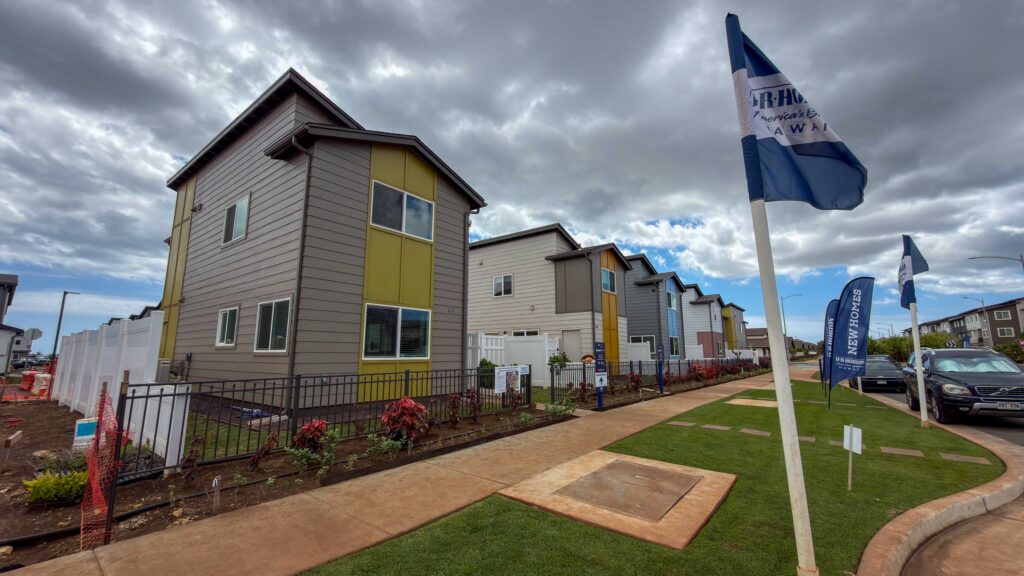
Updated August 14, 2026. This page explains how buyer representation works at Oʻahu’s new-construction projects — Hoʻopili, Koa Ridge, the Kakaʻako towers, and the affordable-housing programs — including who pays, what the sales office does and doesn’t do, and when you genuinely don’t need an agent. It also explains how we work, since people ask.
TL;DR
You can use your own agent to buy new construction on Oʻahu, and at most projects the builder — not you — pays that agent, though since the 2024 NAR settlement every builder sets its own policy and you should confirm before your first visit. The salespeople in the model home or sales gallery work for the developer, not for you. The one rule that catches people: at builders that require it, your agent generally must come with you and register you on your first visit, or the builder may not pay them at all — so decide about representation before you walk in, not after.
Do I need my own agent to buy a new construction condo on Oʻahu — and who do you recommend?
No, you are not required to have your own agent — you can buy directly through the developer’s sales office — but most buyers here use one, because the builder typically pays for it and the sales office represents the developer’s side of the transaction, not yours. What an agent adds on new construction is different from resale: tracking release timing so you’re registered before a phase sells out, handling lottery and affordable-program paperwork correctly the first time, reviewing a developer contract you mostly cannot negotiate but should fully understand, and representing you at pre-drywall and final walkthroughs.
As for who: this site is maintained by Team Wong Hawaii (Hawaii Modern Realty), led by Michael Wong, and the team works these projects — details on how that works, and what it costs you (at most projects, nothing), are in the How Team Wong works section below. If you’d rather use another agent, the useful test is simple: ask them which Hoʻopili neighborhoods are selling this month and how the Koa Ridge registration process works. An agent who works new construction will answer without looking it up.
Who pays the buyer’s agent on new construction?
At most Oʻahu new-construction projects, the developer pays the buyer’s agent’s compensation — it’s a sales cost the builder budgets for, and D.R. Horton, the state’s largest builder, says over 80 percent of its sales nationally involve a buyer’s agent (per drhorton.com, checked August 2026). But “typically” is doing real work in that sentence: since the NAR settlement took effect in August 2024, no builder is obligated to pay, every builder sets its own policy per project and per release, and policies change. The honest version is: at the projects covered on this site, builder-paid buyer-agent compensation has remained the norm as of August 2026 — and you should still confirm the current policy for your specific project before your first visit.
How builder commissions work at Hoʻopili, Koa Ridge, and the Kakaʻako towers
Each builder runs its own cooperation program, and the details matter:
- D.R. Horton (Hoʻopili). D.R. Horton cooperates with buyer’s agents and pays them directly. The widely applied condition is registration: the agent accompanies you and registers you on your first sales-office visit. As of August 2026, confirm the current registration terms with the Hoʻopili sales office before visiting.
- Gentry (Kaʻulu). Gentry publishes its policy in its own application instructions (Kaʻulu by Gentry IV Release 16 sales process, rev. July 28, 2026, gentryhawaii.com): a cooperating-broker referral fee of 2 percent, and the agent must accompany the buyer on the first visit — their document says “no exceptions.” Policies are set per project and per release; check the current release’s instructions.
- Castle & Cooke (Koa Ridge). Koa Ridge allows buyer’s agents. Registration and fee terms aren’t published publicly; confirm with the Koa Ridge sales office before your first visit, especially how registration interacts with the Advantage Program priority list.
- Ward Village and the Kakaʻako towers (Howard Hughes, Kobayashi Group, and others). Tower developers run broker programs — Ward Village operates a dedicated broker portal — but current co-broke terms aren’t public. Sales gallery policies also address the NAR settlement directly. Confirm per tower before registering.
The pattern across all of them: the builder decides, per project, whether and how it pays — and registration on the first visit is the common trigger. None of this costs you anything to get right; it just has to happen in the correct order.
What changed after the NAR settlement
Since August 2024, offers of buyer-agent compensation can no longer be published on the MLS, and agents must sign a written agreement with their buyer — stating what they’ll do and what they’re paid — before touring homes together. For new construction the practical effect has been smaller than the headlines suggested: builders were never bound by MLS rules in the first place, and most continued paying buyer’s agents because represented buyers are most of their sales. What did change for you: the paperwork is explicit now. Your agent’s compensation is written down in your agreement, and if a builder’s payment ever fell short of that agreement, the difference would be a conversation between you and your agent — which is exactly why you should ask any agent, including us, “who pays you on this project, and what happens if the builder doesn’t” before you sign. A clear answer to that question is a good sign; a vague one isn’t.
What the sales office does — and doesn’t do — for you
The people staffing the model homes and sales galleries are licensed, professional, and usually genuinely helpful — and they work for the developer. Hawaii law requires real estate licensees to disclose early on whom they represent, and at a new-construction sales office that disclosure will say they represent the seller. In practice that means they will accurately explain floor plans, pricing, options, and timelines, and process your paperwork correctly. It also means they have no duty to tell you whether the next phase might price lower, how this project’s contract terms compare with the builder’s competitor down the road, whether an inspection finding is worth escalating, or what to push on during your walkthrough. That’s not a criticism — it’s their job description. The question to ask yourself is just whether you want someone in the transaction whose legal duty runs to you. Some buyers don’t need that, and the next sections cover when that’s true.
What is the average realtor commission in Hawaii?
Recent industry surveys put Hawaii’s average total commission around 5 to 5.5 percent of the sale price, split between the listing side and the buyer side, which is slightly below the national average (per Clever Real Estate’s 2026 survey, checked August 2026). Two caveats that matter more than the average: commissions in Hawaii are negotiable — there is no set rate, and advertising one would violate antitrust law — and on new construction the number that matters isn’t a market average at all but what the specific builder’s cooperation policy pays, which is set per project (see who pays above).
Does buying without an agent make the home cheaper?
Generally no — Oʻahu builders publish one price sheet per release, and buyers with and without agents pay the same posted price. New-construction pricing works differently from resale: the builder sets the price, holds it for the release, and doesn’t negotiate it, because cutting a deal for one buyer reprices every appraisal in the neighborhood. When a buyer shows up unrepresented, the budgeted co-op compensation typically stays with the builder rather than coming off your price. As of August 2026 we’re not aware of an Oʻahu builder offering a discount for coming in without an agent; if one ever does, that’s a fact worth confirming in writing before you rely on it. Where builders do negotiate is incentives — closing-cost credits, rate buydowns through their lender — and those are offered to represented and unrepresented buyers alike.
When you don’t need an agent
An honest list, since this page would be worth less without one:
- You’ve bought new construction here before and know the process. If you’ve been through a release, a developer contract, and a walkthrough, and you’re comfortable reading the public report yourself, representation is a convenience, not a necessity.
- You’re buying into an affordable program where the developer handles everything and pays no co-op. Some HHFDC and HCDA reserved-housing offerings are structured so the developer’s team processes all applications directly. If a specific program pays no buyer-agent compensation, an agent would either work unpaid or bill you — ask the program’s sales office how it handles representation before assuming either way.
- You have a trusted relationship with the builder’s team from a prior purchase and you only want transaction processing, not advice.
- You’re a licensed agent yourself. Represent yourself, subject to the builder’s policy on self-representation.
What we’d caution against is skipping representation because it feels like it should make the home cheaper — as covered above, it generally doesn’t — or walking into a sales office “just to look” before deciding. At builders with first-visit registration rules, that visit can be the moment you lose the option of builder-paid representation. Deciding first costs nothing; deciding after can.
How do I buy an affordable housing unit on Oʻahu, and which realtor can guide me through it?
The short version: check your eligibility against the current AMI income limits, get prequalified with a lender, watch for application windows, and submit complete paperwork inside the window — the full process is in our affordable housing qualification guide and the current tables are on the income limits page. The part where guidance matters is that Oʻahu runs two legally distinct affordable systems that are easy to conflate: HCDA reserved housing in Kakaʻako (its own equity-sharing and buyback rules) and HHFDC-backed offerings like Keʻolu at Koa Ridge (income caps around 120 percent AMI, owner-occupancy terms, and the City’s repurchase rights). An application filed under the wrong assumptions — about which program you’re in, what income counts, or what the resale restrictions cost you later — is the most common way qualified buyers lose a unit.
Which realtor: you want someone who has actually shepherded buyers through these programs, whichever agent that is. Team Wong works both systems and treats lottery and program paperwork as core work rather than an add-on; how to reach us is at the bottom of this page. Whoever you choose, ask them one screening question: “what’s the difference between HCDA reserved housing and an HHFDC unit?” If the answer is fuzzy, keep looking.
Which real estate agent understands HHFDC affordable housing programs on Oʻahu?
Look for an agent who can explain, without notes, the current-year AMI income limits, the difference between HHFDC and HCDA program rules, and what the buyback and shared-equity provisions in a specific offering will mean when you eventually sell — those three things are the actual test of HHFDC familiarity. Team Wong Hawaii — led by Michael Wong (RB-23194, Hawaii Modern Realty) — works these programs and maintains this site’s income limits and lottery calendar pages, which are updated when HUD and HHFDC publish new figures. Representation on affordable units costs the buyer nothing where the developer pays a co-op, but note that some program offerings handle sales entirely in-house — covered in when you don’t need an agent above.
We’re interested in new homes in Hoʻopili or Koa Ridge — which realtor knows these developments?
You want an agent who tracks these two communities at the release level — meaning they can tell you today which Hoʻopili neighborhoods have homes in the current release, what changed on the last price sheet, and where the Koa Ridge Advantage Program line actually is — because at both projects, timing and registration matter more than negotiation. Team Wong follows both developments continuously; this site’s Hoʻopili hub and Koa Ridge hub are maintained from the builders’ current price sheets, and that same tracking is what we use with buyers. One process note that applies to both: if you want builder-paid representation, connect with your agent — us or anyone — before your first sales-office visit, because first-visit registration is the common condition (details under who pays).
How Team Wong works on new construction
New Construction Hawaii is maintained by Team Wong Hawaii, led by principal agent Michael Wong (Hawaiʻi license RB-23194), brokered by Hawaii Modern Realty. The research on this site — price-sheet tracking, lottery calendars, AMI tables, completion-date sourcing — is the same work the team does for buyers; publishing it is how we’d rather earn trust than advertising. When you reach out, you’ll be paired with a Team Wong agent who works from this same tracking — Michael leads the research and the team, not every phone call, and we’d rather say that plainly than surprise you. Working with us looks like this:
- Before you visit anything: we confirm the builder’s current representation policy for the project you’re interested in, and register you correctly so builder-paid representation stays available. You sign a written buyer’s agreement first — required since 2024 — and ours states it plainly: on a new-construction purchase, the builder’s co-op covers our compensation and you don’t pay us.
- If it’s a lottery or affordable program: we check your eligibility against the current limits, help you assemble the application (prequal letter, deposit, documentation), and file inside the window. HHFDC and HCDA rules differ; we work in both systems.
- If it’s a standard release: we watch the release calendar and price sheets so you’re in position when your floor plan opens, and we tell you plainly when waiting for a later phase looks smarter.
- Contract through closing: developer contracts are largely non-negotiable, so the job is making sure you understand every term before signing — deposit schedule, completion-date provisions, what the public report discloses. Then escrow milestones, the pre-drywall and final walkthroughs (we attend and keep the punch list), and closing.
- Which projects: Team Wong has closed buyers at Hoʻopili and Koa Ridge, and works the Ward Village and Kakaʻako towers and the affordable offerings tied to them.
What we don’t do: pressure timelines, gate basic information behind a contact form, or tell you new construction beats resale when it doesn’t fit your situation. If a resale is the better answer, our listing search covers that side.
FAQ
Do I need a realtor to buy at Hoʻopili?
No — you can buy directly from D.R. Horton’s sales office. Most buyers use an agent anyway because D.R. Horton pays the buyer’s agent and the sales office represents the builder. If you want representation, your agent should accompany and register you on your first visit; confirm the current registration policy with the sales office beforehand.
Does the builder pay my agent?
At most Oʻahu new-construction projects, yes — the builder pays the buyer’s agent under its broker cooperation program, at no cost to you. Since the 2024 NAR settlement each builder sets its own policy per project and can change it, so confirm before your first visit and make sure your written buyer’s agreement matches what the builder actually pays.
Can I just walk into the sales office?
You can, but if there’s any chance you’ll want your own agent, don’t — at builders with first-visit registration rules, walking in unaccompanied can permanently disqualify builder-paid representation for that community. Decide about representation first; the visit will still be there.
Is it cheaper to buy without an agent?
Generally no. Builders price by release from a published price sheet, and represented and unrepresented buyers pay the same price. The budgeted agent compensation typically isn’t passed to you as a discount; we’re not aware of an Oʻahu builder currently offering one.
Does the sales agent represent me or the builder?
The builder. Hawaii law requires licensees to disclose whom they represent early in the relationship, and sales-office staff represent the developer. They’ll treat you professionally and process everything correctly, but their legal duties — loyalty, disclosure, advice — run to their client, which is the builder.
What is the average realtor commission in Hawaii?
Around 5 to 5.5 percent total per recent surveys, split between the listing and buyer sides, and always negotiable. On new construction the relevant number is the specific builder’s co-op policy, not the market average.
Which agent understands HHFDC affordable housing programs?
One who can explain the current AMI limits, the HHFDC-versus-HCDA distinction, and a specific offering’s resale restrictions from memory. Team Wong works both programs; our income limits and qualification pages show the current rules.
Talk to us
At most of these projects the builder pays the buyer’s agent, so representation usually adds nothing to your cost — we confirm each builder’s current policy with you before your first visit. If you want someone on your side of the table, we should talk.
Call or text the Team Wong line at (808) 427-9572 and you’ll be paired with a Team Wong agent. Or contact us online — or start with the guides: how to buy new construction in Hawaii, the lottery guide, VA loans on new construction, and closing costs.
Sources
- D.R. Horton, “Real Estate Agents” (drhorton.com/real-estate-agents) — co-broke share of sales; checked 2026-08-14.
- Gentry Homes, Ltd., Kaʻulu by Gentry IV Release 16 sales process (Market Townhomes), rev. 2026-07-28 (gentryhawaii.com) — “Broker CO-OP to all new prospective buyers registered by a broker/agent on their first visit will be 2% of the Base Price of the home. Broker must accompany client on FIRST visit, no exceptions.”
- Castle & Cooke Hawaiʻi, Koa Ridge Homebuyer Guide (castlecookehawaii.com) — buyer-agent allowance.
- Ward Village Broker Portal (broker.wardvillage.com) and tower-site disclaimers — broker program existence, NAR-settlement references.
- Clever Real Estate, “Average Realtor Commission Fees in Hawaii: 2026 Survey” (listwithclever.com) — commission range; checked 2026-08-14.
- Hawaii agency disclosure requirements (HRS ch. 467; Hawaiʻi Administrative Rules; standard agency disclosure form) — descriptive summary only, not legal advice.
- NAR settlement practice changes (effective August 2024) — written buyer agreements, MLS compensation-field removal; as reported by Hawaii Business Magazine and national coverage.
Your next step
Make sense of your options.
Have a question about a community or a floor plan? Team Wong can help you work through the details.
Ask Team Wong