ʻAhakea update — September 29, 2026: Detached GenHomes are the first phase; the second phase adds townhomes and attached FLEX homes. Confirm pricing and availability by home type. Compare the two phases.
Hoʻopili pricing note, October 30, 2026: Entry prices at Hoʻopili change with each release, and an advertised community entry is not a promise of a particular bedroom count, FLEX® layout or available home. See current prices on our Hoʻopili page and the dated Hoʻopili pricing guide.
On Oʻahu, the lowest new-construction prices are usually condo flats and condo townhomes at Hoʻopili and Koa Ridge, while Ward Village towers reach well past $2M. Detached homes, such as Nanahea at Hoʻopili, cost more to buy but usually carry the lowest monthly association fees. The right choice depends on your budget, lifestyle, and how much maintenance you want to handle yourself.
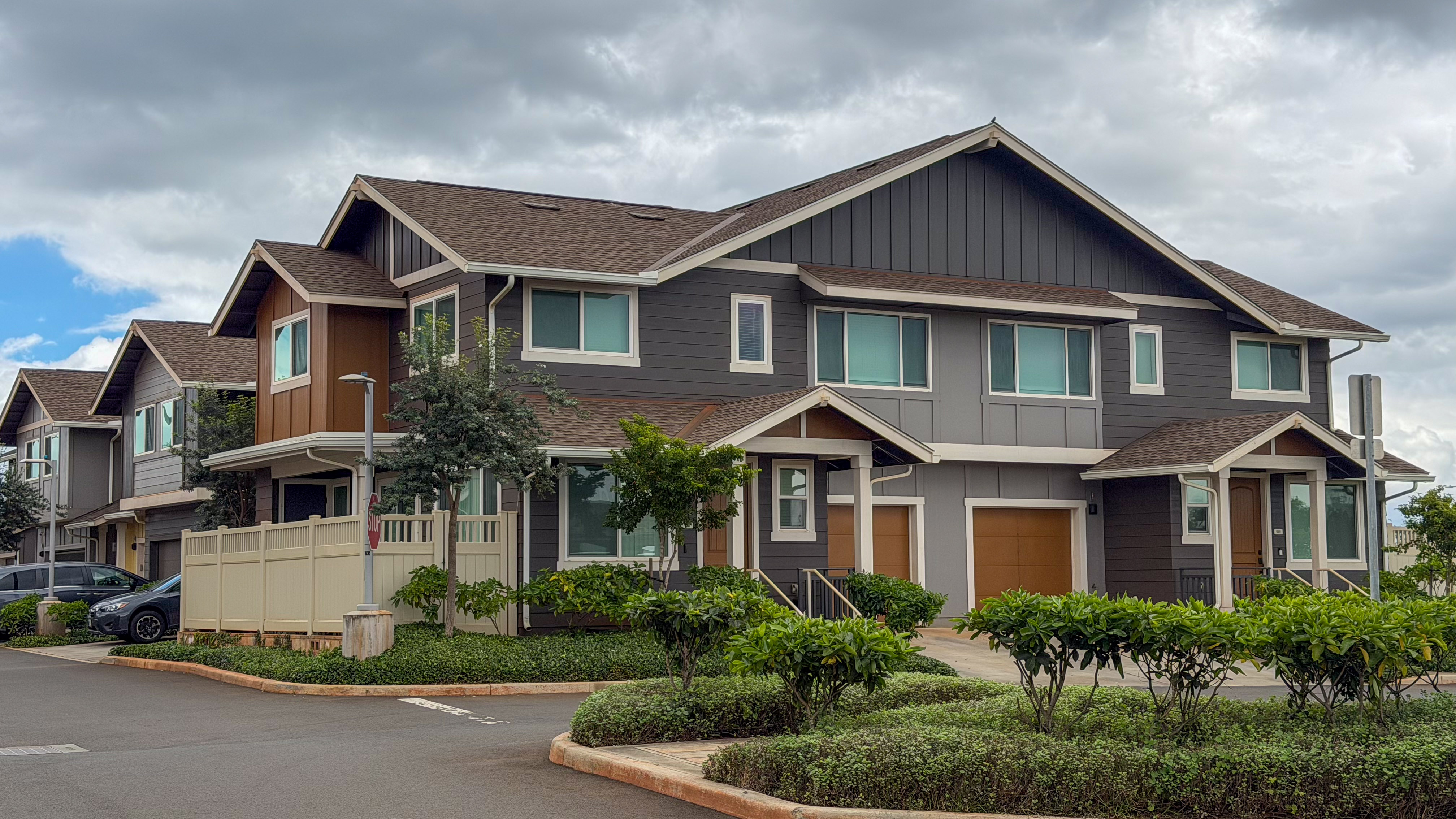
Quick Comparison: Condo vs Townhome vs Single-Family in Hawaiʻi
| Feature | Condo | Townhome | Single-Family |
|---|---|---|---|
| New Construction Price Range (Oʻahu) | Lowest entries (Hoʻopili, Koa Ridge) to $2M+ (Ward Village) | Mid-range; see current Hoʻopili and Koa Ridge prices | Highest; see current Koa Ridge and Hoʻopili prices |
| Typical HOA Fees | $700–$1,800/month | About $400–$1,000/month at Hoʻopili and Koa Ridge, incl. master dues (2025–2026 public reports) | About $55–$200/month (Mililani master dues to new detached condo-regime homes) |
| Maintenance Responsibility | Interior only | Interior + small yard | Everything |
| Outdoor Space | Lanai/balcony | Small yard or courtyard | Full yard |
| Typical Size | 500–1,800 sq ft | 1,000–1,800 sq ft | 1,400–2,500+ sq ft |
| Parking | 1–2 assigned stalls | 2–3 stalls (often attached garage) | 2-car garage + driveway |
| Privacy Level | Low–Moderate | Moderate | High |
| Example Oʻahu Project | Ward Village | Hoʻopili | Koa Ridge |
Understanding Each Property Type in Oʻahu New Construction
Before diving into the pros and cons, it helps to understand what each property type actually means—especially in Hawaiʻi, where ownership structures can differ from the mainland.
Condos
In a new construction condo, you own your individual unit within a larger building. The building’s common areas—lobbies, pools, elevators, hallways, and exterior—are collectively owned by all unit holders and managed by a homeowners association (AOAO in Hawaiʻi). Your monthly fees cover building maintenance, insurance on common elements, water, sewer, and often amenities like fitness centers and concierge service.
At Ward Village in Kakaʻako, The Park opened in June 2026 about 97% sold, Kalae and The Launiu are under construction, and Victoria Place is now resale only. Prices run well past $2 million in the luxury towers. Fees vary by tower and reflect each building’s amenity package; compare them in our Ward Village HOA fees guide.
Townhomes
Townhomes are multi-story attached homes that share one or two walls with neighboring units. In Hawaiʻi new construction, most townhomes are sold as condominium property regime (CPR) units, meaning you technically own a condo interest but live in a house-like structure with your own entrance, garage, and often a small yard or courtyard.
At Hoʻopili in ʻEwa Beach, new townhomes are the dominant home type. The ʻAhakea neighborhood started with detached homes and is adding townhomes and attached FLEX homes in its second phase, while D.R. Horton labels Alana “Sold Out” (checked October 30, 2026). Many Hoʻopili townhomes come with 2–3 parking stalls and smart home features. See current prices on our Hoʻopili page.
Single-Family Homes
Single-family homes are detached structures on their own lot—no shared walls. You own the building and the land beneath it (in fee simple), giving you maximum control over modifications, landscaping, and usage. In new construction developments, single-family homes often still carry a master association fee for community maintenance like parks, trails, and common landscaping.
At Koa Ridge in Waipio, Castle & Cooke is selling detached homes at Nanea III and Mau Loa (see current Koa Ridge prices); earlier Nanea phases started in the high $800,000s and Waioha has closed out. The 2026 master base assessment is $239.34 a quarter (about $80 a month), a fraction of condo fees, covering community common areas and the 7.5-mile Hoʻala Trail pedway. Detached condo-regime homes such as Nanea III also pay a small condo fee.
Condo vs Townhome vs Single-Family: Pricing Breakdown
Here’s how prices compare across Oʻahu’s major new construction developments. Prices change with each release, so check each development page for current figures:
Purchase Prices
Condos offer the widest price range. Uluwehi (572–1,056 sq ft) and Kāpili condo flats at Hoʻopili are among Oʻahu’s lowest-priced new homes (see current Hoʻopili prices), and Ward Village units run from around $600,000 (resale) past $2 million at Kalae and Victoria Place. The tradeoff at the urban end: fewer square feet per dollar, but a walkable location in Kakaʻako with resort-level amenities.
Townhomes hit the sweet spot for many buyers. At Hoʻopili, D.R. Horton labels Alana “Sold Out” (checked October 30, 2026), and ʻAhakea’s second phase adds townhomes. At Kaʻulu in Kalaeloa, Gentry sells market townhomes by release. Keʻolu at Koa Ridge offers income-qualified townhomes through Castle & Cooke’s affordable-housing program; see whether you meet income requirements.
Single-family homes command the highest prices. New detached homes include ʻAhakea’s first phase and Nanahea at Hoʻopili, Nanea III and Mau Loa at Koa Ridge, and Gentry’s single-family releases at Kaʻulu. Their prices reflect more square footage, private yards, and detached living; see current prices on the Hoʻopili, Koa Ridge and Kaʻulu pages.
Monthly Costs Beyond the Mortgage
Your monthly ownership costs vary dramatically by property type. A Ward Village condo with a $740/month HOA fee means $8,880 per year before you factor in your mortgage. A Hoʻopili townhome’s association fees, about $420–$850/month including master dues in 2025–2026 public reports, add roughly $5,000–$10,000 annually. A Koa Ridge single-family home at Nanea III pays about $147/month in master and condo fees, about $1,760 per year, but you’ll budget separately for yard maintenance, exterior repairs, and pest control that condo and townhome HOAs handle for you.
New Construction Advantages by Property Type
Buying new construction in Hawaiʻi comes with benefits that resale properties don’t offer, and those advantages play out differently depending on property type.
Builder Warranties
Most new construction homes in Hawaiʻi come with written builder warranties, and the developer’s public report must describe them (HRS § 514B-83). Typically, you’ll receive a 1-year warranty on workmanship, a 2-year warranty on mechanical systems (plumbing, electrical, HVAC), and a 10-year structural warranty. These apply equally to condos, townhomes, and single-family homes—but the practical difference is that condo structural issues affecting common elements are handled by the AOAO, while single-family homeowners manage warranty claims directly.
Energy Efficiency and Modern Design
New construction across all property types features modern energy-efficient designs, including solar-ready construction, LED lighting, and Energy Star appliances. Ward Village towers are designed to LEED certification standards, incorporating sustainable features like low-flow fixtures, optimized ventilation, and energy-efficient glass. At Hoʻopili and Koa Ridge, smart home technology packages are increasingly standard, with features like smart thermostats and connected security systems.
Pre-Sale vs Move-In Ready
Condos are most commonly sold through a pre-sale process—you purchase before the building is complete, sometimes years in advance. Ward Village’s Kalae, for example, is under construction (completion expected around 2028) after selling in pre-sale. Townhomes and single-family homes in developments like Hoʻopili and Koa Ridge tend to sell closer to completion, often through lottery-based release events where finished or nearly finished homes become available in batches.
Condo vs Townhome vs Single-Family: Lifestyle Comparison
Urban Living: The Condo Lifestyle
Choose a condo if you value walkability, low maintenance, and proximity to dining, shopping, and nightlife. At Ward Village, you’re steps from Ala Moana Beach Park, walking distance to Ala Moana Center, and connected to Honolulu’s urban core. You trade yard space for resort-style pools, fitness centers, and in some buildings, concierge services. This lifestyle appeals to professionals, empty nesters, and anyone who prefers locking the door and leaving without worrying about exterior maintenance.
Suburban Balance: The Townhome Lifestyle
Townhomes offer a middle ground. At Hoʻopili in ʻEwa Beach, you get multiple floors of living space, an attached garage, and a small outdoor area—without the full maintenance burden of a detached home. The development sits beside Skyline rail stations that opened in 2023, and trains now run as far as Middle Street in Kalihi. Townhome living suits growing families, first-time buyers, and military families who want more space than a condo but less upkeep than a house.
Space and Privacy: The Single-Family Lifestyle
Single-family homes at Koa Ridge in Central Oʻahu deliver the most space, privacy, and freedom. You get a private yard for kids, pets, or gardening, a full garage, and no shared walls. The Koa Ridge community adds lifestyle amenities including the 7.5-mile Hoʻala Trail, parks, and planned retail and commercial space. The tradeoff is a longer commute—roughly 25–35 minutes to downtown Honolulu—and full responsibility for exterior maintenance.
Which Property Type Is Best for First-Time Buyers in Hawaiʻi?
For first-time buyers on Oʻahu, the answer depends on your budget and priorities:
- Budget under $600,000: Uluwehi condos at Hoʻopili, Lau Leʻa condo homes at Koa Ridge, or income-qualified Keʻolu townhomes at Koa Ridge (up to 120% AMI); check our income limits guide to see if you qualify.
- Budget $600,000–$800,000: Kāpili condos and ʻAhakea homes at Hoʻopili, Kaʻulu townhomes, or Walea II townhomes at Koa Ridge. Prices move with each release, so confirm on the Hoʻopili and Koa Ridge pages.
- Budget $900,000+: Nanahea at Hoʻopili, Kaʻulu single-family homes, Puaola, Nanea III or Mau Loa at Koa Ridge, or larger condos at Ward Village.
Military families with VA loan eligibility should note that VA loans work for all three property types, but condo buildings must be on the VA’s approved list. In Hawaiʻi, that rule also covers most townhomes and many detached homes, because they are sold as CPR (condominium) units, and approval is granted phase by phase. Check our VA new-construction guide before committing.
Ready to take the next step? Our guide to buying new construction in Hawaiʻi walks you through the entire process, from registration to closing.
Condo vs Townhome vs Single-Family: Decision Framework
Use this framework to narrow your search:
Step 1: Define your commute tolerance. If you work in urban Honolulu and want a short commute, condos in Kakaʻako put you closest to the action. If you work near Pearl Harbor, Joint Base Pearl Harbor-Hickam, or in ʻEwa, Hoʻopili townhomes are well-positioned. Central Oʻahu jobs or remote work pair well with Koa Ridge’s single-family homes.
Step 2: Assess your maintenance comfort. Hate yard work and exterior upkeep? A condo handles it all. Comfortable with a small outdoor space? Townhomes balance privacy with convenience. Want full control over your property? Single-family is the way.
Step 3: Calculate true monthly costs. Don’t just compare purchase prices—factor in HOA fees, maintenance reserves, and expected repairs. A $750,000 townhome with $400/month HOA may cost less monthly than an $850,000 single-family home with $150/month HOA but $500+/month in self-managed maintenance, insurance, and repairs.
Step 4: Consider future flexibility. Condos and townhomes in popular developments tend to have strong rental demand if you relocate. Single-family homes typically appreciate faster in Hawaiʻi’s land-scarce market. Think about your 5–10 year plan.
Real Scenarios: Side-by-Side Monthly Cost Comparison
Here’s how monthly costs might compare for a buyer putting 10% down on each property type:
| Cost Category | Ward Village Condo ($850K) | Hoʻopili Townhome ($700K) | Koa Ridge Single-Family ($900K) |
|---|---|---|---|
| Estimated Mortgage (6.5%) | $4,830 | $3,980 | $5,110 |
| HOA/Association Fees | $740 | $400 | $147 |
| Property Tax (est.) | $250 | $205 | $265 |
| Homeowner’s Insurance | $50* | $120 | $180 |
| Maintenance Reserve | $0** | $100 | $300 |
| Est. Total Monthly | $5,870 | $4,805 | $6,002 |
*Condo insurance covers interior only (HO-6 policy); building insurance is included in HOA. **Exterior maintenance covered by HOA. Figures are estimates for comparison purposes as of early 2026.
Ownership Structure Differences in Hawaiʻi
Hawaiʻi has some unique ownership structures worth understanding:
- Fee simple vs leasehold: Most new construction is fee simple (you own the land), but some older condos are leasehold. All current projects at Ward Village, Hoʻopili, and Koa Ridge are fee simple.
- CPR (Condominium Property Regime): Many townhomes and even some single-family homes in master-planned communities are sold as CPR units. This means the development is legally structured as a condominium even though the homes are detached or attached houses. Nanea at Koa Ridge, for example, consists of single-family CPR homes.
- AOAO vs HOA: Condos have an AOAO (Association of Apartment Owners), while townhomes and single-family communities may have an HOA or both a sub-association and a master association.
For a deeper dive into development-level comparisons, check our Hoʻopili vs Koa Ridge and Ward Village vs Koa Ridge comparison guides.
Frequently Asked Questions
Is it better to buy a condo or townhome in Hawaiʻi?
Compare the specific property rather than assuming townhomes always have lower fees or condos always cost less. Advertised entry prices change with each release and do not price every layout; see current prices on our Hoʻopili and Koa Ridge pages (checked October 30, 2026). Review the home’s living area, parking, maintenance responsibilities, association budget and actual assessment alongside location and purchase price.
How much are HOA fees for new construction in Hawaiʻi?
HOA fees vary widely by property type. Ward Village fees vary by tower and unit size; see our Ward Village HOA fees comparison. At Hoʻopili and Koa Ridge, 2025–2026 public reports put townhome fees at about $400–$1,000/month including master dues, while detached condo-regime homes such as Nanea III and Nanahea run about $150–$200/month. Higher condo fees generally cover more services including building insurance, water, sewer, and extensive amenities.
What is the difference between a townhome and a condo in Hawaiʻi?
In Hawaiʻi, the legal distinction can be blurry—many townhomes are sold as CPR (Condominium Property Regime) units. The practical difference is that townhomes are multi-story attached homes with their own entrance, garage, and often a small yard, while condos are units within a larger building sharing hallways, elevators, and common areas. Townhomes give you more of a single-family-home experience with shared-wall efficiency, while condos offer high-rise amenities and minimal maintenance.
Are single-family homes a better investment than condos on Oʻahu?
Historically, single-family homes on Oʻahu have appreciated faster than condos due to Hawaiʻi’s limited land supply. However, new construction condos in prime locations like Ward Village have also shown strong value retention. Consider that detached homes at Koa Ridge, such as Nanea III, carry low association fees (about $150/month in master and condo fees, 2025–2026 public reports), meaning more of your payment builds equity rather than covering shared expenses. The best investment depends on location, development quality, and your hold period.
Can I use a VA loan to buy a condo in Hawaiʻi?
Yes, but the condominium project must be on the VA’s approved list, and many towers apply only near or after completion. In Hawaiʻi, townhomes and many detached homes are sold as CPR (condominium) units, so they need the same project approval, granted phase by phase. Military families stationed at Joint Base Pearl Harbor-Hickam or Schofield Barracks often find Hoʻopili townhomes and Koa Ridge single-family homes particularly accessible with VA financing.
What does CPR mean for Hawaiʻi townhomes and single-family homes?
CPR stands for Condominium Property Regime—a legal ownership structure where a development is registered as a condominium regardless of the physical form of the homes. At Koa Ridge, even detached single-family homes in the Nanea neighborhood are CPR units. This means you own your unit and a share of common areas, and you’re subject to association rules and fees. For financing purposes, CPR homes are treated similarly to condos by lenders, so confirm your loan type works with CPR ownership.
Which is best for first-time home buyers in Hawaiʻi: condo, townhome, or single-family?
For a first purchase, start with your budget, space needs and total monthly cost. Builders reprice entry homes with each release, so check current prices on our Hoʻopili and Koa Ridge pages (checked October 30, 2026) and confirm a specific available home; for income-qualified options, use the current release’s application and eligibility documents. No home type guarantees future appreciation.
How do new construction warranties work in Hawaiʻi?
New construction homes in Hawaiʻi typically come with tiered warranties: 1 year on workmanship and materials, 2 years on mechanical systems (plumbing, electrical, HVAC), and 10 years on structural components. These warranties apply to condos, townhomes, and single-family homes alike. For condos, structural warranty claims on common elements are managed by the AOAO, while individual homeowners handle interior claims. For single-family homes, you manage all warranty claims directly with the builder.
Your next step
Buying new for the first time?
Team Wong can walk you through the contract, the deposits and the timeline before you visit a sales office.
Ask Team Wong