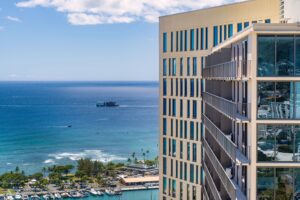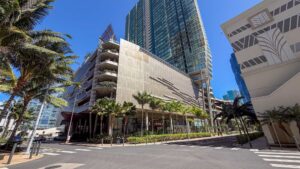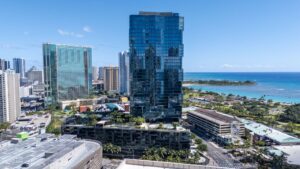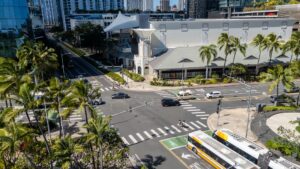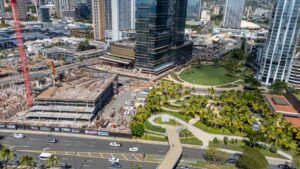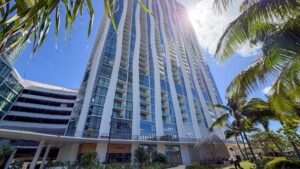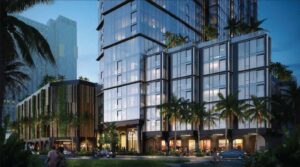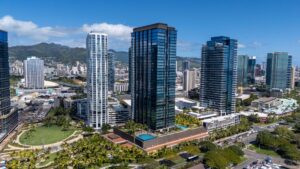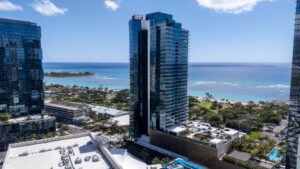
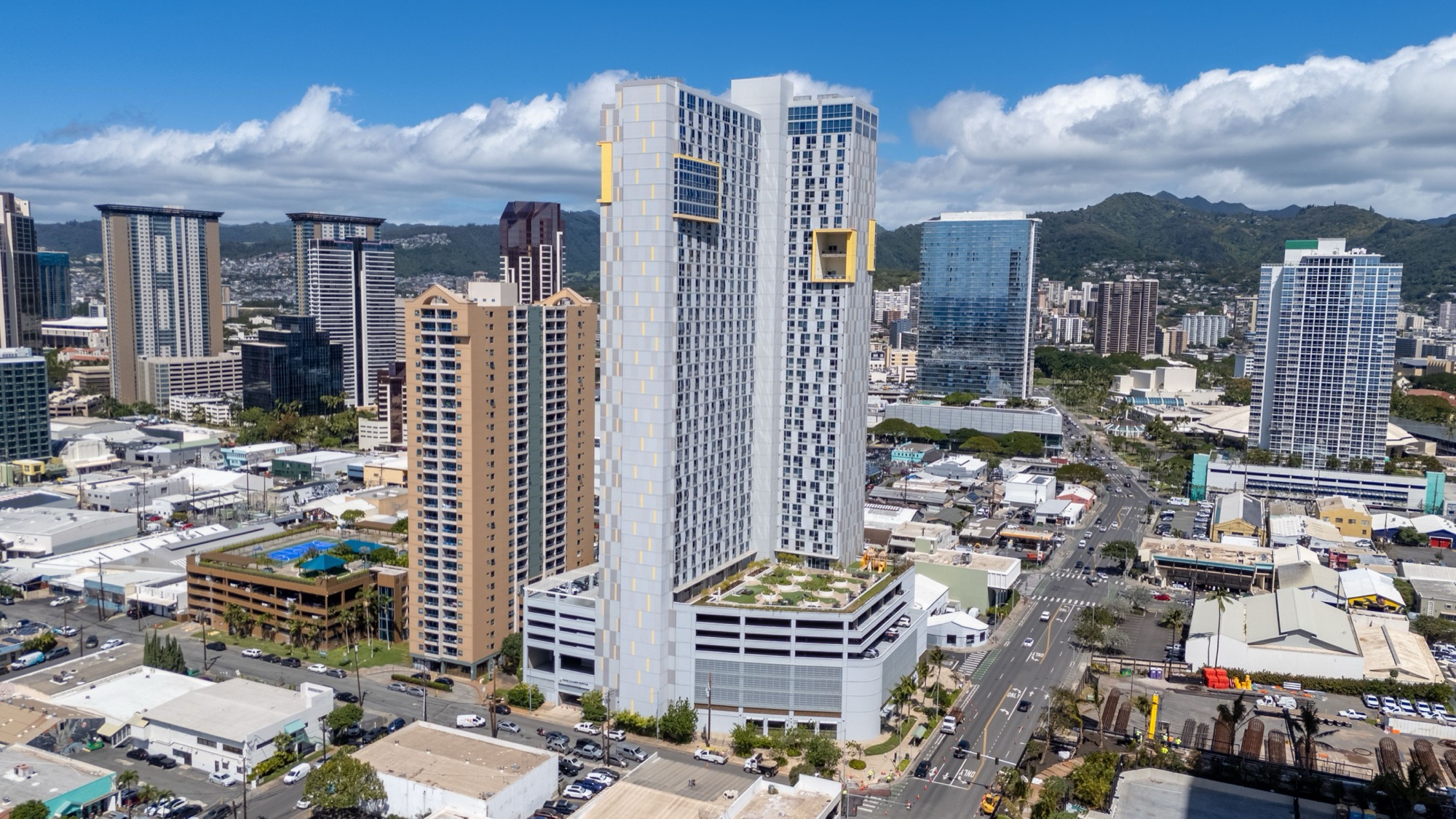
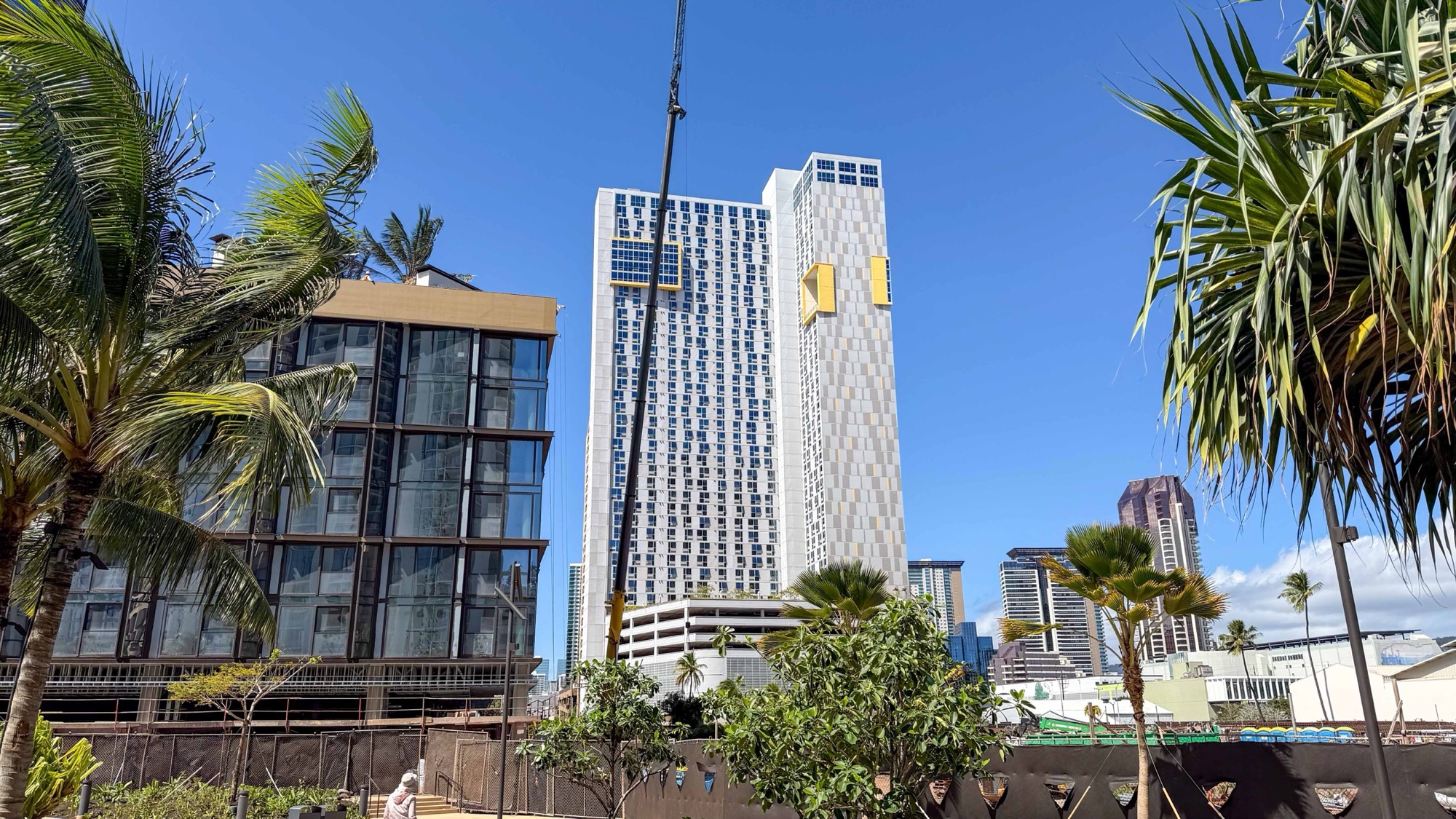
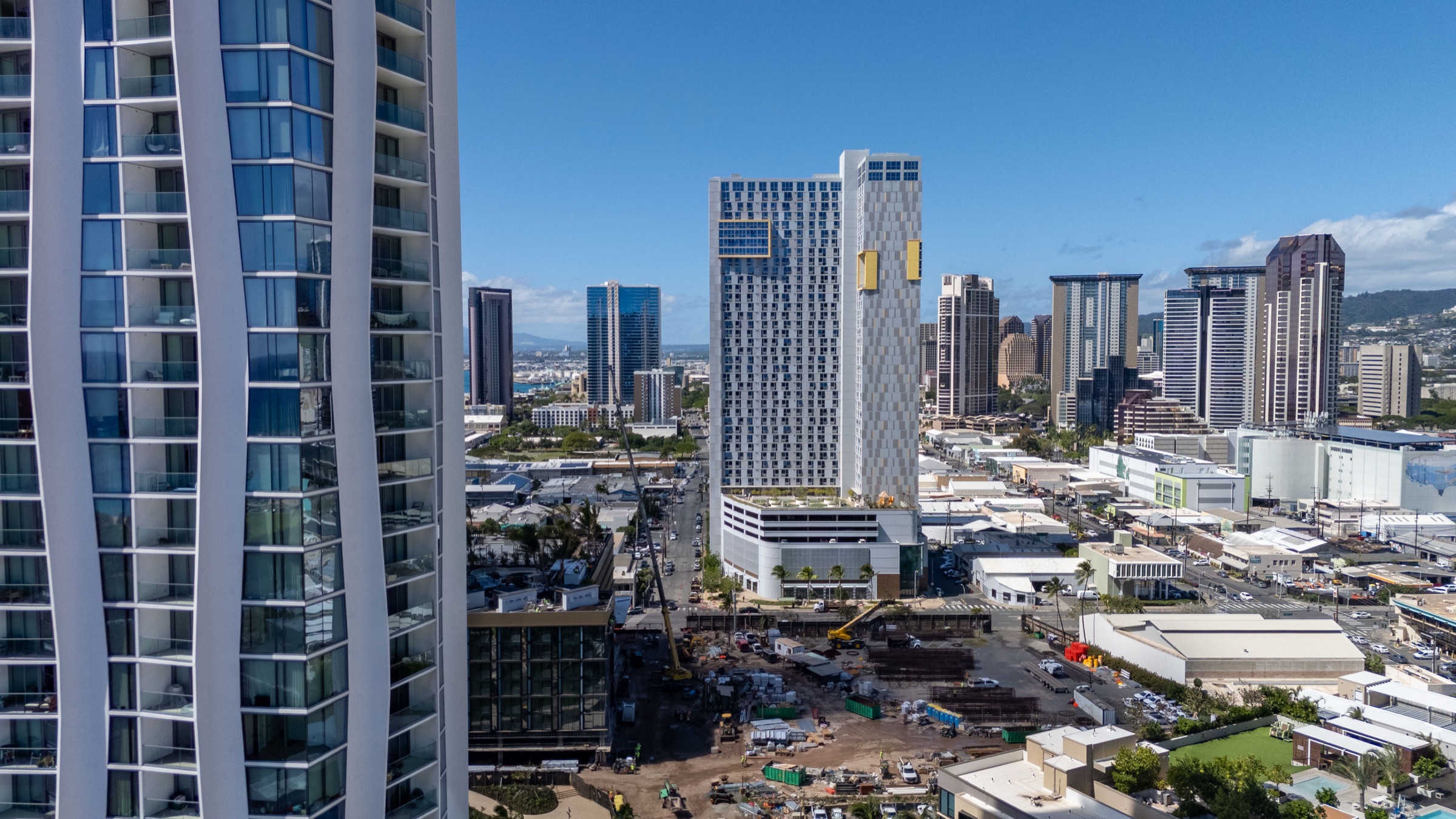
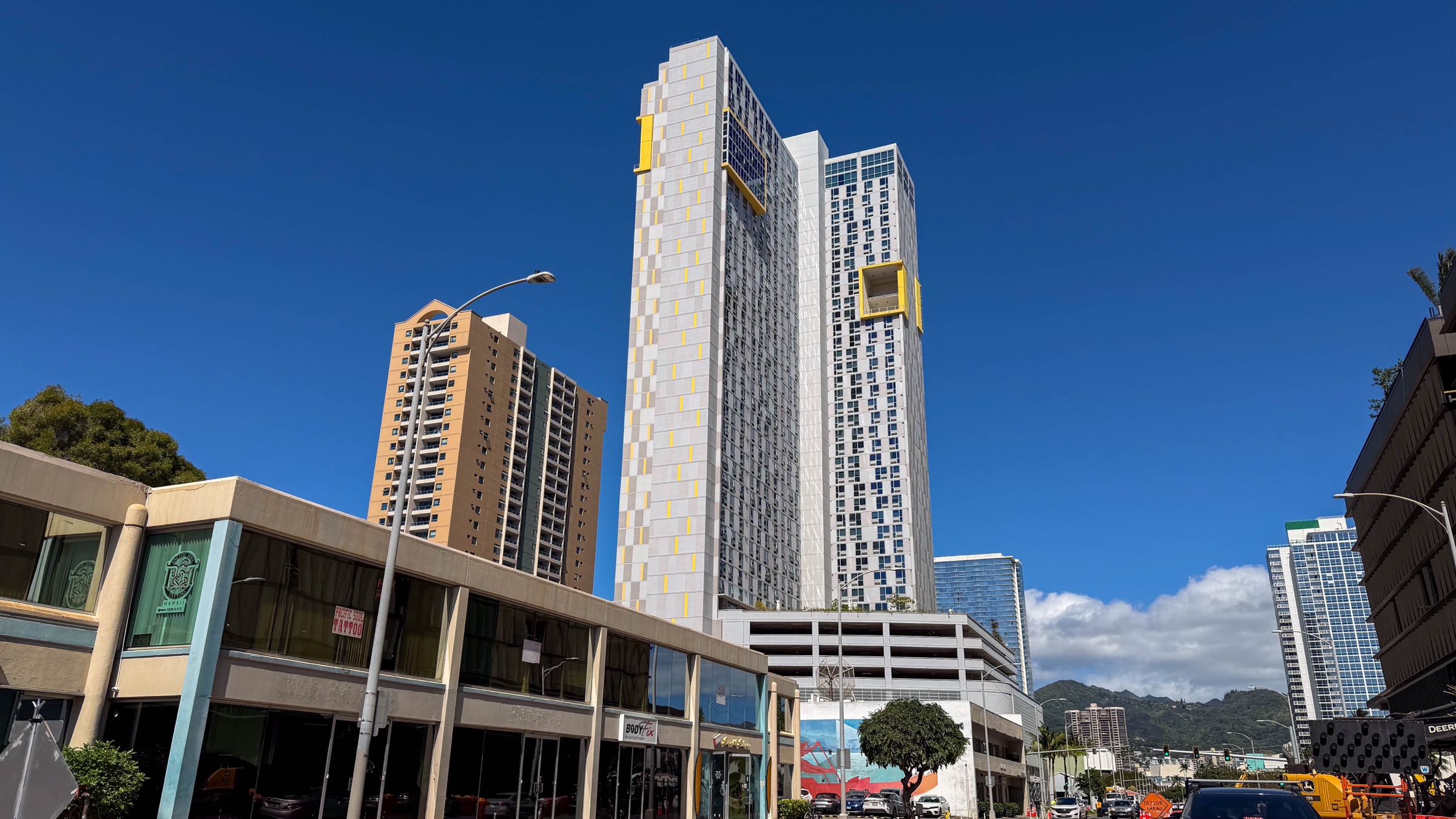
Ke Kilohana is a 43-story, 424-unit condominium tower completed in 2019 at 988 Halekauwila Street in Kakaʻako, Honolulu. Developed by The Howard Hughes Corporation as part of the Ward Village master plan, Ke Kilohana stands out for dedicating 88% of its units (375 of 424) to reserved housing—far exceeding Hawaiʻi’s typical 20% affordable housing requirement. The name “Ke Kilohana” means “the very best” in Hawaiian, reflecting its status as one of the tallest residential buildings in Kakaʻako.
Quick Facts: Ke Kilohana at a Glance
- Address: 988 Halekauwila Street, Honolulu, HI 96814
- Completion Year: 2019 (blessing ceremony May 14, 2019)
- Developer: The Howard Hughes Corporation / Victoria Ward Limited
- Construction Company: PCL Construction
- Architect: AC Martin (Los Angeles) with CDS International (Honolulu)
- Height: 43 stories (~418 feet)
- Total Units: 424 (375 reserved housing + 49 market-rate)
- Unit Mix: 1-3 bedroom condos, 461-2,070 sq ft
- Parking: Approximately 780 stalls (floors 1-6)
- Retail: ~23,000 sq ft ground floor (Longs Drugs/CVS—closing June 2026)
- Original Pricing: $323K-$560K (reserved housing)
- Current Resale Pricing: $499K-$1.3M
Building Specifications: 43 Stories of Mixed-Income Housing
Ke Kilohana contains 424 residential units across 43 stories, with 375 units designated as reserved housing and 49 market-rate units. This 88% reserved housing ratio makes Ke Kilohana one of the most affordable-focused high-rise projects in Hawaiʻi, dramatically exceeding the Hawaii Community Development Authority’s (HCDA) minimum 20% requirement for Kakaʻako developments.
The building’s architectural design by AC Martin incorporates traditional Hawaiian kapa (bark cloth) patterns into its facade, creating a distinctive visual identity that honors local culture while achieving modern density. The tower rises from a six-story parking podium containing approximately 780 stalls, with ground-floor retail formerly anchored by a Longs Drugs (CVS) flagship location—the store closed on June 10, 2026, and a replacement tenant has not been announced as of July 2026.
Unit Mix Breakdown
Ke Kilohana offers 141 one-bedroom units (461-511 sq ft), 191 two-bedroom units (742-800 sq ft), and 92 three-bedroom units (978-1,173 sq ft), plus approximately 6-12 penthouse units ranging from 1,550-2,070 sq ft.
| Unit Type | Count | Size Range (sq ft) |
|---|---|---|
| 1-Bedroom | 141 | 461-511 |
| 2-Bedroom | 191 | 742-800 |
| 3-Bedroom | 92 | 978-1,173 |
| Penthouses | 6-12 | 1,550-2,070 |
The diverse unit mix was intentionally designed to serve a range of household sizes, from young professionals to families. One-bedroom units are compact but efficiently designed, while three-bedroom units provide enough space for growing families—a rarity in urban Honolulu’s reserved housing inventory.
Reserved Housing Explained: What “Affordable” Really Means
Ke Kilohana’s reserved housing units serve households earning 100-140% of Area Median Income (AMI), which translates to $106,400-$148,960 annually for a single person or $152,000-$212,800 for a four-person household in 2025. This income bracket targets middle-class professionals—teachers, nurses, police officers, and other essential workers—rather than the lowest-income residents.
The HCDA’s reserved housing program requires that housing costs (mortgage, property taxes, insurance, HOA fees) not exceed 33% of gross monthly income. When Ke Kilohana launched sales in 2016, units were priced to meet this affordability threshold based on projected maintenance fees of $270-$525 per month. However, actual maintenance fees have proven significantly higher—a controversy we’ll address in detail below.
2025 Income Qualification Limits
| Household Size | 100% AMI | 120% AMI | 140% AMI |
|---|---|---|---|
| 1 Person | $106,400 | $127,680 | $148,960 |
| 2 Persons | $121,600 | $145,920 | $170,240 |
| 3 Persons | $136,800 | $164,160 | $191,520 |
| 4 Persons | $152,000 | $182,400 | $212,800 |
| 5 Persons | $164,200 | $197,040 | $229,880 |
2026 update: HHFDC’s current schedule puts 100% AMI for a four-person household at $154,000 and 120% AMI at $184,800. Check the current HHFDC/HCDA income table when qualifying — see our income limits guide.
Beyond income limits, reserved housing buyers must meet additional eligibility requirements:
- Must be U.S. citizen or permanent resident
- Must be Hawaiʻi resident (bona fide domicile)
- Must be 18+ years old
- Cannot have owned a principal residence within 3 years prior (first-time homebuyer requirement)
- Maximum assets (excluding retirement accounts) = 125% of applicable income limit
- Must obtain pre-qualification from HCDA-approved lender
- Must commit to owner-occupancy during regulated term
The 2016 Lottery Process
Ke Kilohana held its reserved housing lottery in April 2016, drawing from approximately 1,000 qualified applicants for 375 available units—roughly 1-in-3 odds. The process began with informational seminars in late 2015 that attracted over 3,500 attendees, reflecting the intense demand for affordable homeownership in urban Honolulu.
Prospective buyers had to attend a mandatory seminar, submit notarized affidavits documenting their eligibility, and obtain pre-qualification letters from approved lenders (Honolulu HomeLoans or First Hawaiian Bank). The lottery drawing occurred on April 15, 2016, via webcast, with unit selection beginning the following day.
All 375 reserved housing units sold within five days of the selection period—a testament to the scarcity of affordable homeownership opportunities in Kakaʻako. Over 400 buyers remained on the waitlist after sellout, though current resale procedures for reserved housing units remain less transparent than the original lottery process.
Pricing History: The Affordability Gap Widens
Original reserved housing prices at Ke Kilohana ranged from $323,475 for one-bedroom units to $560,774 for three-bedroom units (2016-2019). As of August 2026, resale listings run from $499,000 to about $1.3 million (nine actives; 1-bedrooms cluster $520K–$589K)—representing 50-100% appreciation in just 5-7 years.
Original Sales Prices (2016-2019)
| Unit Type | Reserved Housing Price Range |
|---|---|
| 1-Bedroom | $323,475 – $442,246 |
| 2-Bedroom | $473,789 – $538,612 |
| 3-Bedroom | $521,774 – $560,774 |
Current Resale Market (checked August 2026)
| Unit Type | Current Asking Prices | Price per Sq Ft |
|---|---|---|
| 1-Bedroom | $499,000 – $589,000 | $1,009 – $1,165 |
| 2-Bedroom | $525,000 – $849,000 | $708 – $1,140 |
| 3-Bedroom | $895,000 – $1,275,000 | $915 – $981 |
This dramatic appreciation reflects several factors: Kakaʻako’s transformation into Honolulu’s premier urban neighborhood, limited inventory of new construction condos, and strong demand from buyers who missed the original lottery. However, it also highlights a fundamental tension in reserved housing policy: units intended to be “affordable” have become unaffordable again through market appreciation.
As of February 2026, approximately 6-7 units are actively listed for sale, with an average time on market of ~100 days. The building maintains a 76% owner-occupancy rate, suggesting most buyers are using their units as primary residences rather than investment properties—a positive indicator of the program’s intent being realized.
The Maintenance Fee Controversy: Projected vs. Reality
Ke Kilohana’s maintenance fees have become a major source of controversy. Original 2016 projections estimated $270/month for 1-bedroom units, $400/month for 2-bedroom units, and $525/month for 3-bedroom units. Actual fees in 2026 are approximately $631/month, $1,082/month, and $1,736/month respectively—increases of 134% to 231%.
| Unit Type | Original Projection (2016) | Actual (2020+) | Current (2026) | % Increase |
|---|---|---|---|---|
| 1-Bedroom | $270/mo | $631/mo | ~$631/mo | +134% |
| 2-Bedroom | $400/mo | $800/mo | ~$1,082/mo | +171% |
| 3-Bedroom | $525/mo | $1,181/mo | ~$1,736/mo | +231% |
The Association of Unit Owners filed litigation against Howard Hughes Corporation, alleging that developers grossly underestimated operating costs to artificially render reserved housing units affordable under HCDA affordability criteria. A 53.44% fee increase in 2020 significantly impacted owners who had budgeted based on original estimates, with some reporting that their total housing costs now exceed 40-50% of income—well above the 33% threshold that defines “affordable.”
Several factors contribute to the higher-than-projected fees:
- Building Complexity: 43-story tower with extensive amenities requires significant staffing and maintenance
- Insurance Costs: Hawaii’s high-rise insurance market has experienced dramatic increases post-2018
- Reserve Fund Requirements: Proper funding of long-term reserves (roof replacement, elevator modernization, etc.) requires higher monthly contributions
- Inflation: Costs projected in 2014-2015 proved insufficient in the actual 2019+ operating environment
- Underestimation: Potential developer incentive to minimize projected fees to make affordability calculations work
This controversy has broader implications for Hawaiʻi’s reserved housing program. If maintenance fee projections are routinely lowballed to achieve affordability thresholds, buyers face financial stress when actual costs emerge. Industry observers suggest HCDA should require third-party validation of operating cost projections and potentially establish reserve funds to cushion owners against dramatic fee increases in the early years.
Amenities: Resort-Style Living at 43 Stories
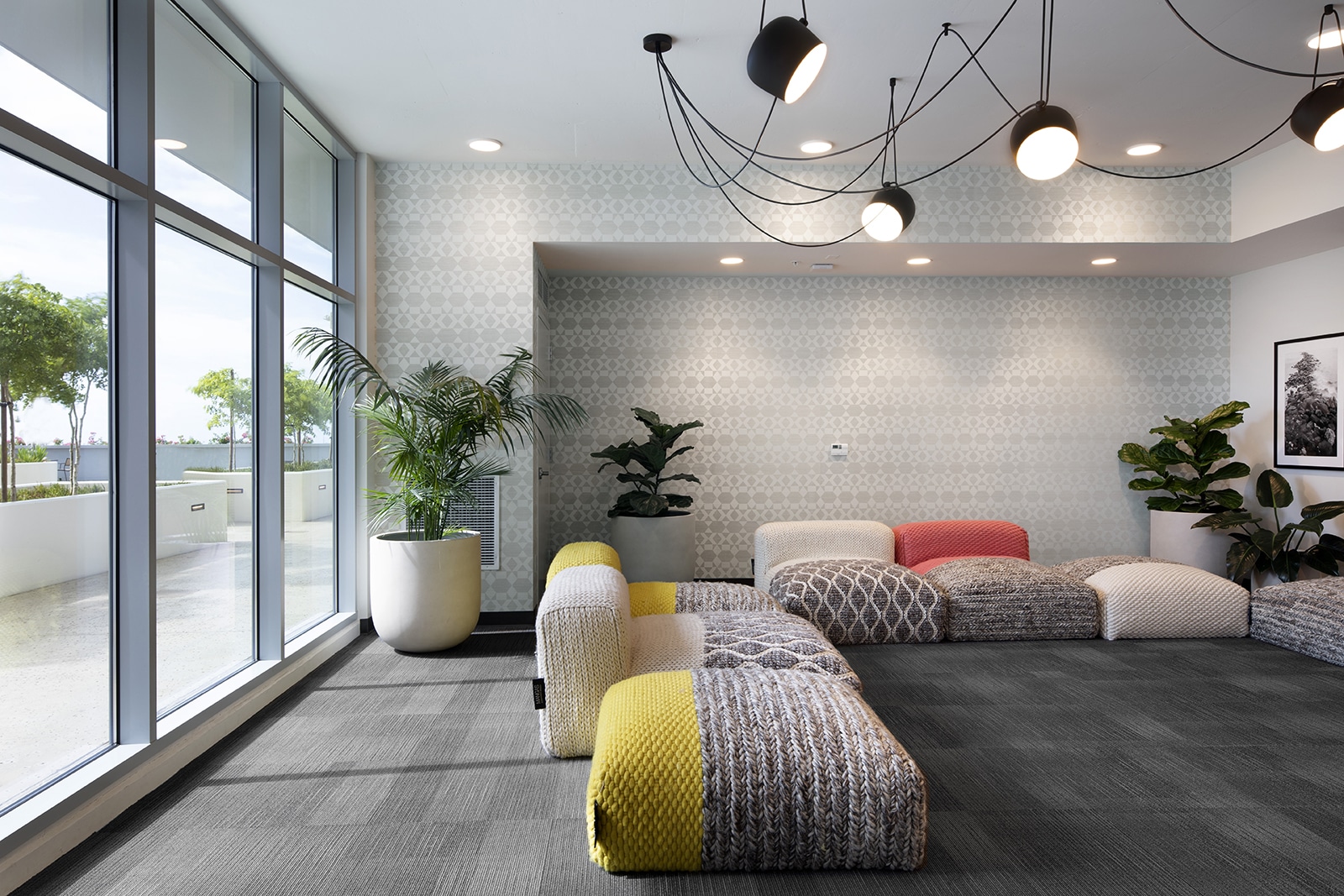
Ke Kilohana features two signature Sky Lānai on the 31st floor with panoramic views from Diamond Head to Kewalo Basin, plus a comprehensive amenity deck on the 8th floor. The amenity package rivals luxury market-rate developments, reflecting Howard Hughes Corporation’s strategy of delivering high-quality reserved housing rather than stripped-down “affordable” units.
Sky Lānai (31st Floor)
The twin Sky Lānai offer makai (ocean-facing) and ʻewa (west-facing) orientations, providing residents with spectacular sunset and ocean views. These spaces serve as outdoor gathering areas for residents, hosting community events and offering a quiet retreat above the city.
8th Floor Amenity Deck
- Fitness Center: Modern equipment with on-demand workout studio
- Private Theater: Movie screenings and community events
- Music Studio: Soundproofed with professional acoustics
- Karaoke Room: Entertainment venue for residents
- Dog Park: Enclosed pet area—a rare amenity in urban high-rises
- BBQ Deck: Multiple grilling stations with outdoor seating
- Co-working Space (“The Hub”): Meeting rooms with complimentary WiFi
- Children’s Play Areas: Indoor and outdoor options
- Reading Room: Quiet study and relaxation space
- Bike Storage: Secure facility promoting alternative transportation
- Surfboard Storage: Reflects Hawaiʻi’s outdoor lifestyle
The extensive amenity package contributes to the building’s higher maintenance fees but also enhances quality of life for residents. Families with children particularly benefit from the play areas and BBQ deck, while remote workers appreciate the co-working space—especially relevant in the post-pandemic era of hybrid work.
Shared Equity & Resale Restrictions: Understanding the Fine Print
Ke Kilohana reserved housing units are subject to perpetual shared equity requirements that survive even after initial regulated terms expire. This is one of the most misunderstood aspects of HCDA reserved housing, with many buyers unaware that affordability restrictions continue indefinitely.
Regulated Terms (2-10 Years)
During the initial regulated term, owners face strict restrictions:
| Buyer Income Level | Regulated Term | Restrictions |
|---|---|---|
| < 100% AMI | 10 years | Owner-occupancy required; cannot rent; HCDA buyback right |
| 100-119% AMI | 5 years | Owner-occupancy required; cannot rent; HCDA buyback right |
| 120-140% AMI | 2 years | Owner-occupancy required; cannot rent; HCDA buyback right |
If an owner wishes to sell during the regulated term, HCDA has first right of refusal to purchase at a formula-determined price—typically the lower of current fair market value minus HCDA’s equity share, or original sales price adjusted for AMI changes.
Perpetual Shared Equity Requirement
Even after the regulated term expires, sellers must pay HCDA a “shared equity” amount equal to the original subsidy received. The formula (under 2005 HCDA rules governing Ke Kilohana) calculates shared equity as the higher of:
- Fixed amount: Original Fair Market Value minus Original Sales Price, OR
- Percentage: [(Original FMV – Original Sales Price) / Original FMV] × Net Appreciation
Example Calculation:
- Original Fair Market Value: $700,000
- Original Purchase Price (reserved housing): $500,000
- Subsidy/Shared Equity Owed: $200,000
- If unit sells for $800,000: Owner keeps $100,000 appreciation; HCDA receives $200,000
- Owner nets: $600,000 ($800,000 sale price – $200,000 shared equity)
This structure ensures the public subsidy is recycled to future affordable housing programs rather than becoming private wealth. However, it also limits the wealth-building potential that traditional homeownership provides—a tradeoff buyers must carefully consider.
A 2021 amendment allows owners to prepay shared equity without selling, effectively exiting the program while retaining the unit. This option provides flexibility for owners who achieve financial success and wish to convert their unit to unrestricted ownership.
Location & Neighborhood: Ward Village Adjacent
Ke Kilohana sits at 988 Halekauwila Street in the heart of Kakaʻako, directly adjacent to Ward Village’s luxury residential and retail district. The location offers exceptional walkability, with restaurants, shops, entertainment venues, and beach parks within a 5-15 minute walk.
Walking Distance Amenities
- Ward Village Retail: Whole Foods, Nordstrom Rack, T.J. Maxx, restaurants (5-minute walk)
- Ala Moana Center: Hawaii’s largest shopping mall (15-minute walk)
- Kewalo Basin Harbor: Fishing charters, ocean activities (10-minute walk)
- Kakaʻako Waterfront Park: Beach parks, pavilions, ocean views (12-minute walk)
- Mother Waldron Park: Community park with playground (8-minute walk)
- Our Kaka’ako: Weekly farmers market and community events (7-minute walk)
The neighborhood has transformed dramatically over the past decade from light-industrial warehouses to Honolulu’s densest urban district. Ward Village’s master plan envisions 4,500 residential units across 22 acres, with Ke Kilohana playing a key role in providing workforce housing alongside luxury developments like Waiea, Anaha, and Ae’o.
Transit & Parking
Ke Kilohana’s ~780 parking stalls (approximately 1.8 spaces per unit) exceed minimum requirements, though buyers should verify parking allocation in their specific unit purchase. The building’s location along Halekauwila Street provides easy access to major thoroughfares including Ala Moana Boulevard and Piikoi Street.
Honolulu’s Skyline rail now runs from East Kapolei to Middle Street (Segment 2 opened October 2025), and a Kakaʻako station near Ward Village is planned for the final city-center segment (~2031; the Ala Moana extension has been deferred). Once open, rail will provide direct connections to West Oahu, Daniel K. Inouye International Airport, and downtown Honolulu—potentially reducing the need for car ownership in this walkable neighborhood.
Retail Concerns: CVS/Longs Closure
The ground-floor Longs Drugs (CVS) pharmacy closed on June 10, 2026, eliminating convenient pharmacy and sundries access for residents. The 23,000 sq ft space represents a significant retail vacancy, though Ward Village’s Whole Foods and other retailers remain nearby. Future retail tenants will shape the building’s ground-floor character and resident convenience.
Pros and Cons: An Honest Assessment
Advantages
- Accessible Entry Point: Original pricing $200K-$400K below market-rate condos provided genuine opportunity for middle-income buyers
- Premier Location: Ward Village adjacency offers urban walkability rarely accessible at reserved housing prices
- Extensive Amenities: Sky Lānai, fitness center, theater, dog park rival luxury developments
- New Construction: Modern systems, warranty coverage, decades before major capital improvements needed
- Community Feel: High owner-occupancy rate (76%) creates stable, engaged resident base
- Equity Building: Even with shared equity requirements, owners build wealth through principal paydown and partial appreciation capture
- Family-Friendly: Three-bedroom units and children’s amenities accommodate growing families
Disadvantages
- Maintenance Fee Shock: Fees 130-230% higher than projected create significant financial stress for buyers on tight budgets
- Limited Wealth Building: Shared equity requirements reduce appreciation capture compared to unrestricted homeownership
- Perpetual Restrictions: Even after regulated term expires, shared equity obligations continue indefinitely
- Resale Uncertainty: Less liquid market than unrestricted condos; buyer pool limited to HCDA-qualified households or those willing to prepay shared equity
- Dense Living: 424 units in one tower means elevator waits, crowded amenities during peak times
- HOA Litigation: Ongoing legal disputes with developer create uncertainty and potential special assessments
- CVS Closure: Loss of ground-floor pharmacy reduces convenience
- No Short-Term Rentals: Regulated terms prohibit renting; even after expiration, HOA rules may restrict rental income
Who Should Consider Ke Kilohana?
Best Fit: Middle-income professionals planning long-term owner-occupancy (5+ years) who prioritize location over maximum wealth building. Ideal for those who missed the original lottery and qualify for HCDA reserved housing income limits.
Proceed with Caution: Buyers on tight budgets (housing costs approaching 40% of income), those expecting traditional homeownership appreciation, investors seeking rental income, or buyers who may relocate within 2-5 years.
Comparison to Similar Developments
Ke Kilohana fits within a broader ecosystem of Kakaʻako and urban Honolulu reserved housing projects:
- Keauhou Place (2017): Nearly identical to Ke Kilohana (43 stories, 423 units), developed by Stanford Carr Development with similar HCDA reserved housing requirements. Provides useful comparison point for maintenance fees and resale values.
- The Central Ala Moana (2021): 512-unit tower with 310 HHFDC affordable units (60% affordable). Serves broader income range (80-140% AMI) with 10-year restrictions plus shared appreciation equity.
- Nohona Hale (2020): 111-unit rental tower serving 30-60% AMI households with 30-61 year affordability restrictions. Fundamentally different model (perpetual rental vs. for-sale ownership).
Ke Kilohana’s 88% reserved housing ratio exceeds most mixed-income projects, reflecting Howard Hughes Corporation’s strategy of concentrating affordable units in specific towers rather than distributing them across all Ward Village developments.
The Bottom Line
Ke Kilohana represents both the promise and challenges of Hawaiʻi’s reserved housing program. It delivered hundreds of homeownership opportunities to middle-income families in one of Honolulu’s most desirable neighborhoods—an achievement that shouldn’t be understated given Hawaii’s extreme housing costs.
However, the maintenance fee controversy and perpetual shared equity requirements reveal tensions in the model. Buyers who budgeted carefully based on developer projections faced financial stress when actual costs emerged 130-230% higher. The shared equity structure limits wealth building compared to traditional homeownership, raising questions about whether the program truly creates economic mobility or simply provides subsidized rental-like occupancy with ownership responsibilities.
For prospective buyers, the key is entering with eyes wide open: understand the true total cost of ownership (including realistic maintenance fee projections), recognize that resale restrictions limit both flexibility and appreciation capture, and ensure you’re committed to long-term occupancy in this specific building and neighborhood. If those factors align with your needs, Ke Kilohana offers urban Honolulu living at prices unattainable in the unrestricted market. If you need maximum flexibility or wealth-building potential, traditional market-rate condos may better serve your goals—even at higher entry prices.
As Kakaʻako continues evolving and more reserved housing towers reach the end of their regulated terms, the long-term outcomes of this grand experiment in inclusionary zoning will become clearer. Ke Kilohana’s experience—both successes and struggles—will inform future affordable housing policy in Hawaiʻi for decades to come.
Frequently Asked Questions
How much do Ke Kilohana units cost?
Original reserved housing prices ranged from $323,475-$560,774 (2016-2019). Current resale prices range from $499,000 for 1-bedroom units to about $1.3 million for 3-bedroom units (checked August 2026). Market-rate units command higher premiums.
What are the maintenance fees?
As of 2026, maintenance fees range from approximately $631/month for 1-bedroom units to $1,736/month for 3-bedroom units. These fees are significantly higher (130-230%) than original 2016 projections of $270-$525/month.
Can I rent out my Ke Kilohana unit?
Not during the regulated term (2-10 years depending on income level). After the regulated term expires, rental may be permitted subject to HOA rules, but shared equity obligations continue perpetually.
What is shared equity and does it ever expire?
Shared equity is the difference between original fair market value and the subsidized purchase price. When you sell, HCDA receives this amount to fund future affordable housing. This obligation is perpetual—it never expires, even after the regulated term ends.
How do I qualify for reserved housing at Ke Kilohana?
You must earn 100-140% of Area Median Income ($106K-$149K for individuals, $152K-$213K for 4-person households in 2025), be a Hawaii resident, be a U.S. citizen or permanent resident, not have owned a home in the past 3 years, and meet asset limits of 125% of applicable income limit.
Is there a waitlist for Ke Kilohana?
The original 2016 lottery waitlist is likely exhausted. Current resale availability varies; contact the building’s sales office or HCDA to inquire about available reserved housing units.
What happened with the maintenance fee lawsuit?
The Association of Unit Owners filed litigation against Howard Hughes Corporation alleging developers underestimated operating costs to meet affordability thresholds. The litigation highlights discrepancies between projected and actual fees. Check with the HOA for current status.
Can I prepay the shared equity and exit the program?
Yes. A 2021 HCDA amendment allows owners to prepay the shared equity amount without selling, converting the unit to unrestricted ownership. This option provides flexibility for owners whose financial situation improves.
How does Ke Kilohana compare to Keauhou Place?
Both are 43-story towers completed in the late 2010s with similar unit counts (~423-424 units) and HCDA reserved housing requirements. Keauhou Place was developed by Stanford Carr Development. Comparing maintenance fees and resale values between the two provides useful market context.
Did the ground-floor Longs Drugs/CVS close?
Yes. The Longs Drugs (CVS) location closed on June 10, 2026. A replacement tenant has not been announced as of July 2026.
What is the owner-occupancy rate?
Approximately 76% as of recent data, indicating most units serve as primary residences rather than investment properties or vacation rentals.
Will the Honolulu Rail reach Ke Kilohana?
The planned Kakaʻako station would be within walking distance. Skyline currently runs from East Kapolei to Middle Street; the Kakaʻako segment is expected around 2031, and the Ala Moana extension has been deferred.
Related reading: the Ward Village development hub, Ulana Ward Village (Kakaʻako’s newest 100% reserved housing tower), and the Hawaii affordable housing lottery guide.
Ready to Explore New Construction in Person?
Our team specializes in Oʻahu new construction and can help you navigate lotteries, financing, and the buying process. Compensation is negotiable and set out in your written buyer agreement. Confirm any builder contribution before committing.
Contact KJ HarrisonNew Construction Hawaiʻi is a resource by Team Wong Hawaii · Hawaii Modern Realty